
Wplan: Asset Allocation tool for RM
WPLAN is a digital investment advisory platform used by relationship managers at Siam Commercial Bank to support high-net-worth customers in building and managing investment portfolios. The tool helps relationship managers assess risk tolerance, compare investment products, rebalance portfolios, execute transactions, and track performance over time.

Wplan: Investment advisory tool
Investment advisory platform, iPad application
Siam Commercial Bank (SCB)
Apr 2019 - Nov 2020
Researcher, UX and UI designer
Challenge
Despite a large base of customers holding deposits above 5 million baht, relationship managers rarely used WPLAN during client meetings. Only 11 percent of RMs used the tool to generate and present investment proposals, relying instead on paper documents and external systems.
This limited adoption reduced the bank’s ability to convert deposits into managed investments and weakened the advisory experience for both RMs and customers.
Results
After releasing the redesigned portfolio comparison and rebalance experience, we observed measurable improvements across usability, adoption, and efficiency.
User satisfaction increased from 3.5 to 5.2 out of 7, based on post-usability testing surveys
Advisory feature adoption increased from 11 percent to 27 percent
Relationship managers reduced time spent during client meetings by approximately 30 percent, as fewer explanations, recalculations, and system switching were required
The reduction in meeting time was driven by clearer portfolio comparison, faster rebalance adjustments, and improved numeric input interactions. RMs were able to explain recommendations more efficiently and spend more time on strategic discussion rather than operational tasks.
30%
Reduce in time on task
16%
Increase in feature adoption
3.5 → 5.2
Improve in user satisfaction
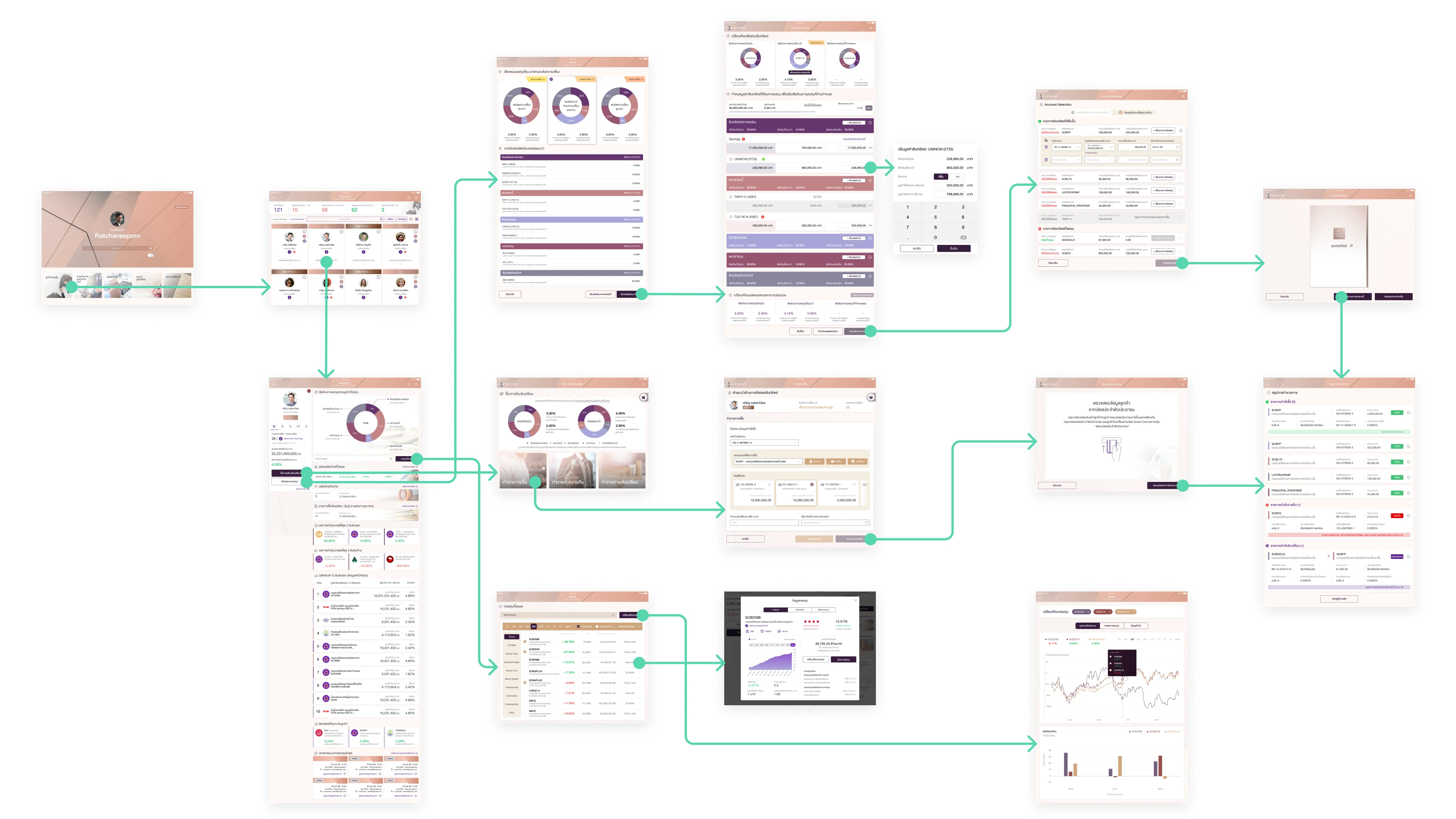
Business Context
Siam Commercial Bank had a substantial customer base of high-net-worth individuals with deposit accounts valued over 5 million baht. However, the bank was failing to convert these customers into investment clients effectively. The primary challenge was that only 11% of relationship managers were actively using Wplan to generate investment proposals.
The bank identified key objectives:
Help customers grow their wealth through structured advisory services
Improve an advisory tool that RMs could effectively use to present investment portfolios
Enable RMs to confidently present and adjust portfolios during client meetings
Increase adoption of the digital advisory tool and reduce reliance on paper-based transactions
Process & User Research Methodology
The project followed a structured double diamond design approach:
Empathise Phase - User interviews and stakeholder interviews
Define Phase - Problem statements, persona development, user journey mapping
Ideate Phase - User flow design, feature identification
Detail Phase - Low-fidelity wireframes, high-fidelity wireframes, prototypes
Test Phase - Usability testing, stakeholder reviews, design critiques
Deliver Phase - Final design elements and implementation
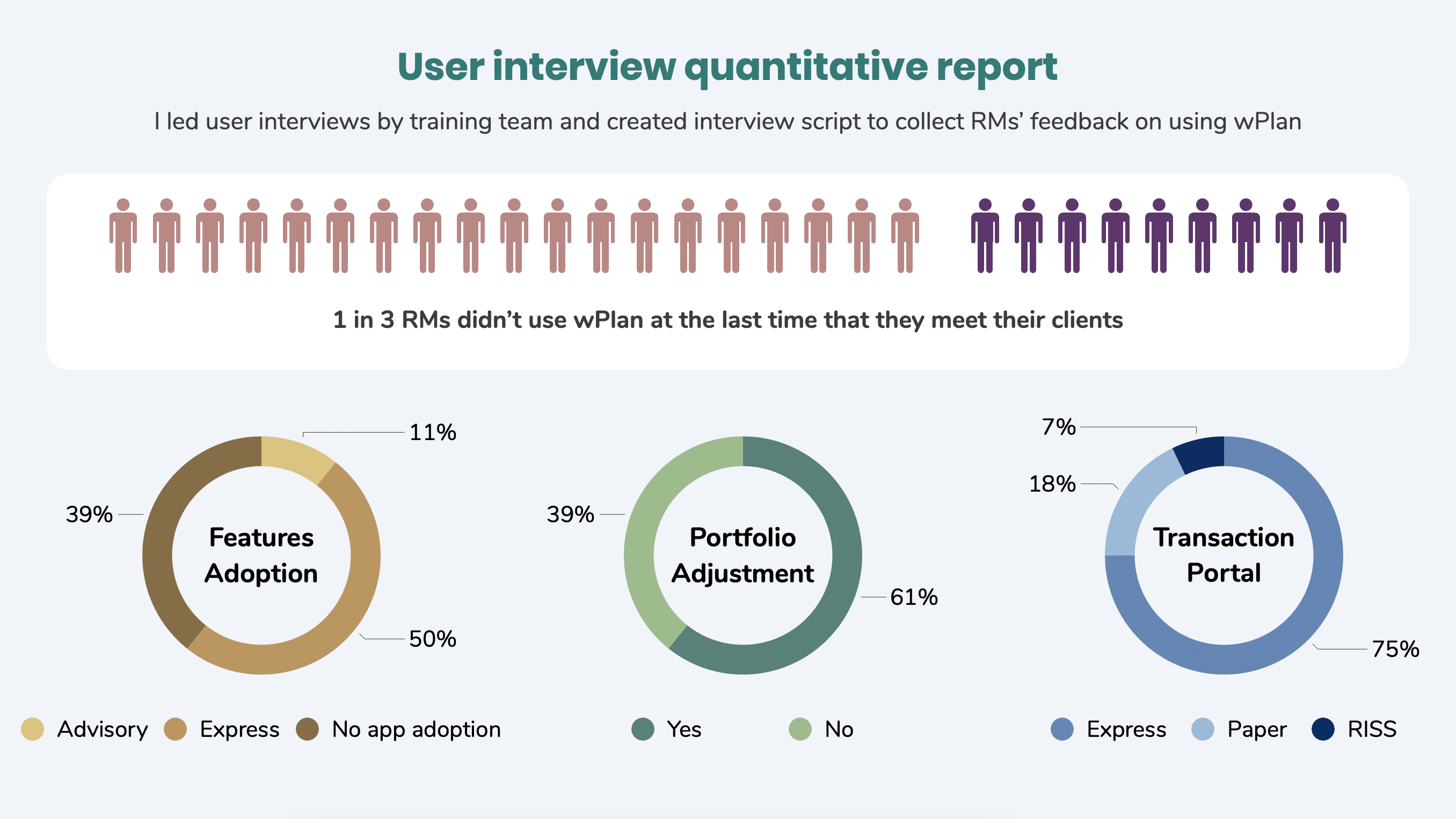
I led comprehensive user interviews and created interview scripts to collect feedback from relationship managers. The research revealed critical insights about actual platform usage and user pain points.
Key Findings from User Interviews
Feature Adoption Rates:
Advisory feature adoption: 11% (significantly underutilized)
Portfolio Adjustment usage: 39%
No app adoption: 50% of RMS
Transaction Portal usage: 7% (mostly using paper: 75%)
Critical Pain Points Identified:
One in three RMs did not use WPLAN during their most recent client meeting
Rebalancing inputs were difficult and error-prone, especially numeric entry
RMs had to switch between multiple systems to compare funds
CIO-recommended portfolios often contained more than 10 assets, making it difficult for RMs to understand and explain them
Customers preferred making small, selective investments rather than full portfolio changes
“ I have to bring a calculator to client meetings and manually enter more than 20 assets. It disrupts the flow and doesn’t convey a professional image in front of business owners. ”

Nuttapon Chaisakul
RM
User Context
Primary users:
Relationship managers are responsible for advising high-net-worth customers.
Customer context:
Wealthy customers at SCB had distinct characteristics influencing design decisions:
Age demographics: Most customers are over 45 years old; some are uncomfortable with technology and lack email
Behavioral patterns: Entrepreneurs, doctors, and politicians with tight schedules
Investment experience: Diverse - from first-time investors avoiding high-risk assets to sophisticated investors
Technology adoption: Older customers showed lower comfort with the iPad; younger customers (under 45) had lower investment budgets
Solutions
I redesigned the portfolio comparison and rebalance experience with a focus on clarity, guided decision-making, and ease of adjustment.
Key improvements included:
Simplified rebalance interactions with clearer controls
Progressive disclosure of portfolio details
Improved numeric input patterns for accuracy and speed
Better visual hierarchy to support explanation during meetings
Multiple design iterations were tested and refined, moving from dense data tables to more structured, scannable layouts that supported conversation flow rather than system logic.
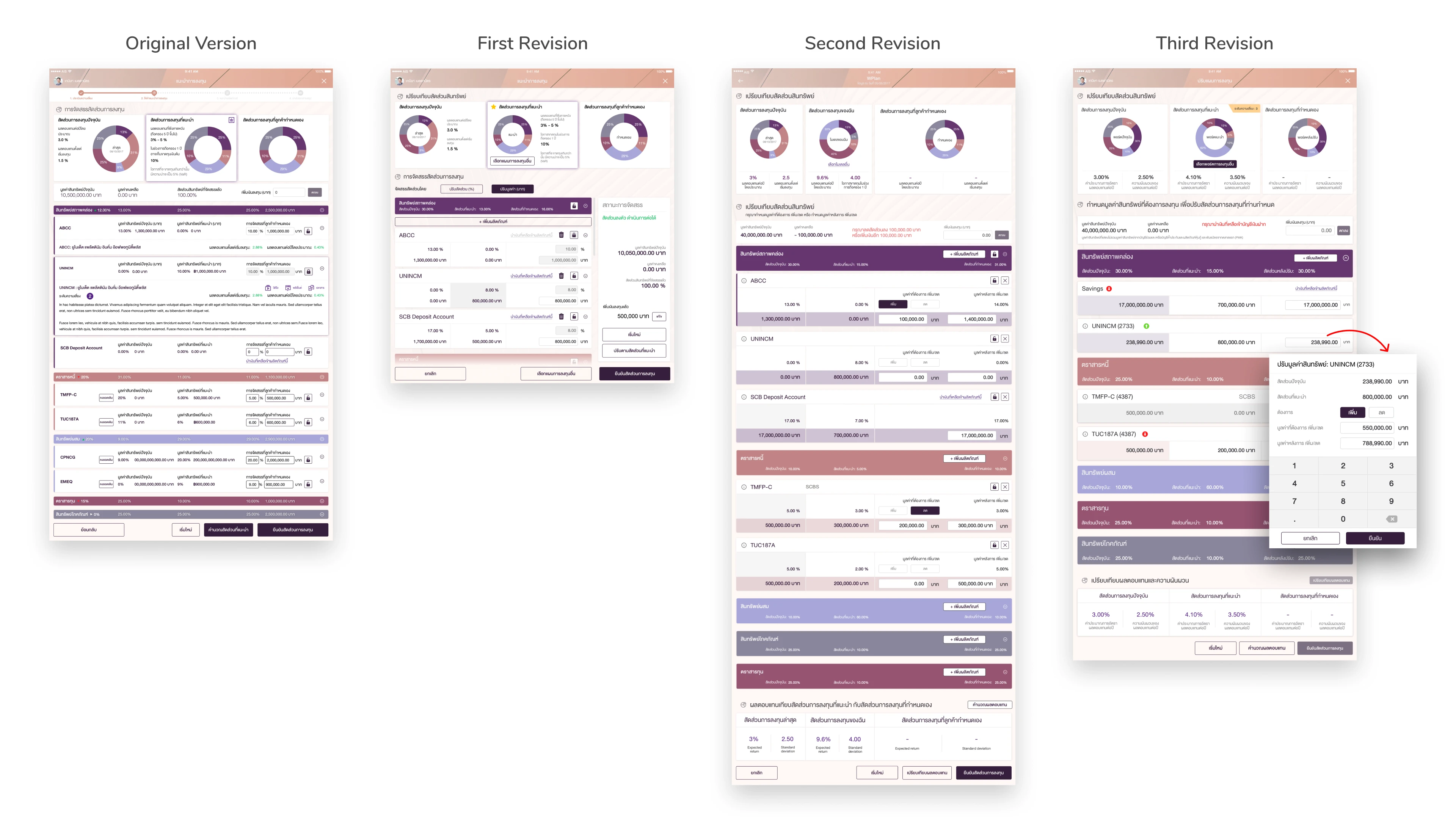
Design Iterations
The rebalance experience went through three major design iterations, driven by usability findings from RM interviews, design critiques, and testing. Each iteration progressively reduced cognitive load, clarified decision-making, and improved confidence during live client conversations.
Early iterations. Identifying the core usability problems
The initial design displayed all recommended assets simultaneously, often more than 10 funds, alongside complex numerical inputs. This made it difficult for RMs to understand and explain how changes affected the portfolio clearly.
Key challenges included:
Information overload caused by long, unstructured fund lists
Poor distinction between current allocation, system-recommended allocation, and RM-proposed adjustments
Tedious manual number entry that increased input errors during meetings
Lack of a clear summary showing the overall impact of rebalancing decisions
As a result, RMs struggled to guide clients through portfolio changes efficiently, especially in time-constrained, face-to-face settings.
Evolving to an Optimized Rebalance Experience
Based on insights from earlier iterations, the design evolved from a data-dense, system-driven layout into a guided interaction model that better reflected how relationship managers conduct advisory conversations with customers.
Instead of exposing all information at once, the experience was restructured to clearly separate portfolio states and support step-by-step adjustment. The goal was to reduce cognitive load during live meetings while preserving transparency and control.
The final rebalance experience was introduced:
Tabbed navigation to distinguish between Current, Recommended, and Custom portfolio allocations
Asset class grouping by Liquidity, Bonds, Mixed Assets, Equities, and Commodities, replacing long flat fund lists
Intelligent input controls that allowed both percentage-based and amount-based adjustments
Real-time visual feedback, including remaining cash indicators and reallocation requirements
Clear before-and-after comparison using key investment metrics:
Expected annual return
Standard deviation (volatility)
Expected return over a 10-year holding period
Value at Risk (VaR)
Risk transparency was further strengthened through a clearly visible 1 to 5 risk scale, enabling RMs to explain trade-offs between return and volatility in a way customers could easily understand.
By aligning the interaction model with real advisory workflows, the redesigned experience reduced friction during portfolio discussions. Relationship managers could adjust allocations faster, explain recommendations more clearly, and maintain confidence throughout the conversation. This shift transformed the rebalance flow from a complex operational task into a collaborative advisory tool that supported better decision-making for both RMs and customers.
Validation and Testing
After stakeholder alignment, I conducted usability testing with 12 relationship managers to validate the redesigned advisory and rebalance experience.
Method and objectives
Participants: 12 relationship managers with mixed experience levels and age groups
Objectives:
Validate understanding of portfolio recommendations
Assess the efficiency of the rebalance workflow
Measure confidence when presenting to customers
Identify remaining usability issues
Key results
67 percent of participants (8 out of 12) reported higher confidence using the advisory feature
User satisfaction increased from 3.5 to 5.2 out of 7
Post-launch adoption increased from 11 percent to 27 percent, driven by clearer interactions and reduced friction
Key insights
Participants highlighted clearer portfolio visualization, easier allocation adjustments, and a more intuitive flow for explaining risk and return trade-offs.
These results confirmed that simplifying the interaction model directly improved trust, confidence, and real-world usage.
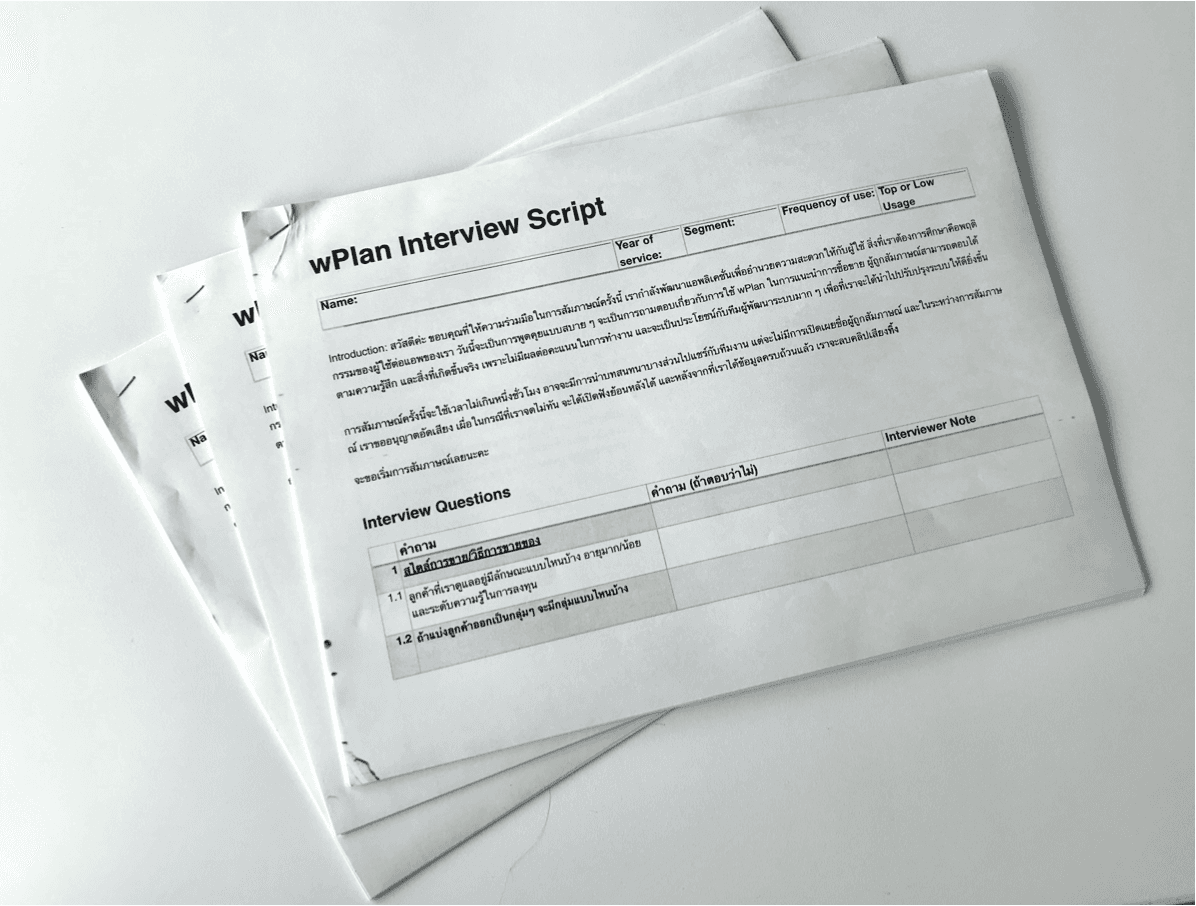
Usability test script
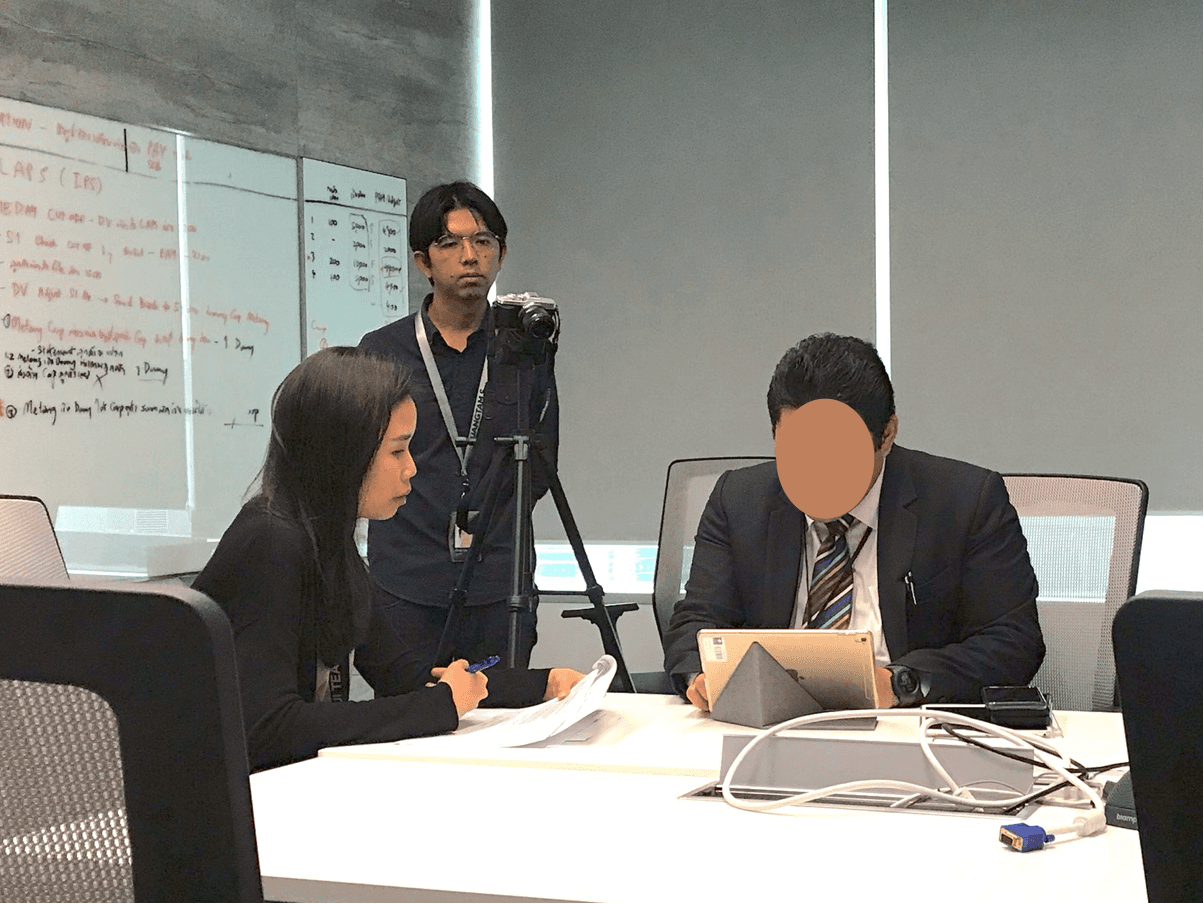
Usability testing session with RM
Impact & Outcomes
Quantitative outcomes
After releasing the redesigned portfolio comparison and rebalance experience, we observed measurable improvements across usability, adoption, and efficiency.
User satisfaction increased from 3.5 to 5.2 out of 7, based on post-usability testing surveys
Advisory feature adoption increased from 11 percent to 27 percent
Relationship managers reduced time spent during client meetings by approximately 30 percent, as fewer explanations, recalculations, and system switching were required
The reduction in meeting time was driven by clearer portfolio comparison, faster rebalance adjustments, and improved numeric input interactions. RMs were able to explain recommendations more efficiently and spend more time on strategic discussion rather than operational tasks.
User impact
RMs reported higher confidence in presenting investment recommendations during live client meetings
Portfolio adjustments became easier to explain and validate with customers in real time
Reduced cognitive load allowed RMs to focus on advisory conversations rather than system navigation
Many RMs described the experience as feeling more “guided” and less transactional, especially when working with time-constrained or less tech-comfortable customers.
Business impact
Increased usage of the digital advisory tool reduced reliance on paper-based proposals and manual workflows
Shorter, more effective meetings allowed RMs to serve more customers without increasing workload
Improved advisory adoption supported the bank’s goal of converting high-value deposit customers into managed investment portfolios
Reflection and conclusion
This project reinforced the importance of designing for real-world constraints, particularly in high-stakes, face-to-face advisory contexts. Improving usability alone was not enough. The experience needed to actively support trust, explanation, and confidence during live customer conversations.
By grounding design decisions in both qualitative insights and quantitative validation, the redesigned portfolio comparison and rebalance experience removed key usability barriers that had limited adoption. Focusing on clarity, efficiency, and confidence-building through iterative design and usability testing resulted in a 2.5x increase in feature adoption, higher user satisfaction, and more effective advisory interactions.
This case study demonstrates how user-centered design in financial services can directly influence business outcomes. By making complex investment data easier to understand and discuss, Wplan evolved from a transactional tool into a strategic advisory asset for Siam Commercial Bank’s wealth management operations.